 Umesh Pande
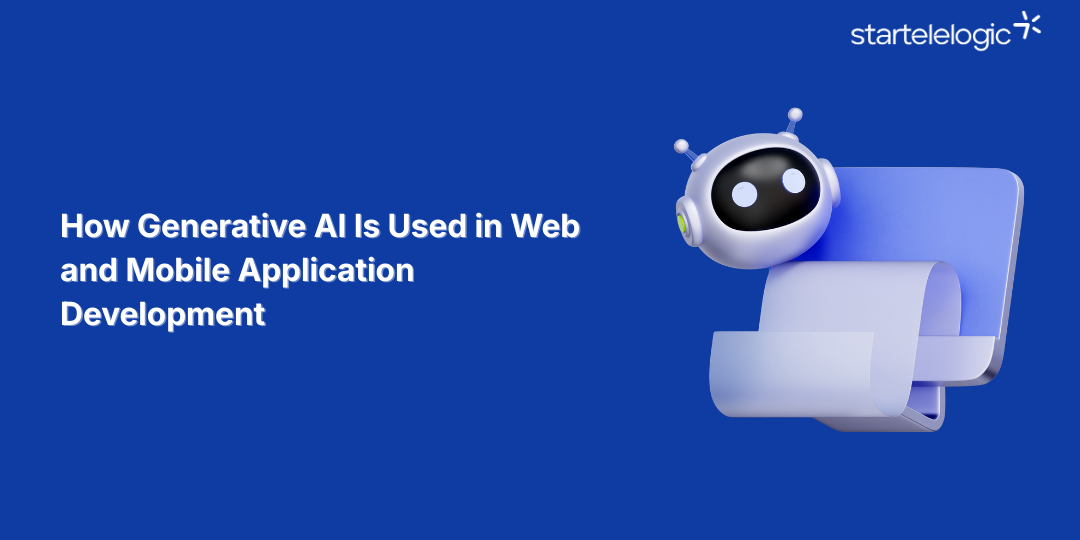
Generative AI is no longer just a buzzword—it is actively reshaping how teams imagine, design, and build digital products. From startups creating rapid prototypes to large enterprises scaling complex platforms, Generative AI in Web and Mobile App Development now drives modern software innovation. Instead of relying on long development cycles, large teams, and endless iterations, organizations use intelligent AI-driven tools to accelerate workflows and improve efficiency.
Today, Generative AI in Web and Mobile App Development is helping organizations build smarter, scalable, and more user-focused applications by combining automation with human creativity.
In this article, we explore how developers use generative AI in web and mobile app development, examine real-world use cases and benefits, and understand how this technology is shaping the future of app development in a more human-centered way.
Understanding Generative AI in App Development
At its core, generative AI refers to systems that can create content—code, text, images, layouts, and even design logic—based on patterns learned from massive datasets. In Generative AI in app development, these systems assist developers by generating code snippets, automating repetitive tasks, suggesting improvements, and even building entire components with minimal human input.
Rather than replacing developers, generative AI acts as a collaborative partner. It enhances creativity, reduces manual effort, and allows development teams to focus more on problem-solving, innovation, and user experience instead of boilerplate work.
How Generative AI Is Used in Software Development
When we look at how generative AI is used in software development, the impact spans the entire lifecycle of an application. From planning and design to development, testing, and deployment, AI-powered tools are improving speed and accuracy at every stage.
During development, AI models can generate clean, functional code based on natural language prompts. Developers can describe what they want, and the AI produces a working solution. In testing, generative AI helps create test cases, identify edge scenarios, and even predict potential bugs. This results in more stable applications and faster release cycles.
AI-Powered Web Development: Smarter and Faster Builds
AI-powered web development is transforming how websites and web applications are built. Generative AI can analyze user requirements and automatically generate front-end components, backend logic, and APIs. Developers no longer need to start from scratch every time—they can build on AI-generated foundations.
Web development frameworks integrated with AI tools can also optimize performance, recommend best coding practices, and adapt layouts for responsiveness. This ensures web applications are not only functional but also scalable and performance-driven.
AI in Mobile App Development: Personalization at Scale
In AI in mobile app development, generative AI plays a critical role in personalization and efficiency. Mobile apps thrive on user engagement, and AI-driven systems can analyze behavior patterns to dynamically adapt content, layouts, and features for individual users.
Generative AI also accelerates mobile development by producing platform-specific code for Android and iOS, reducing cross-platform inconsistencies. This allows teams to launch high-quality apps faster while maintaining a consistent user experience across devices.
Generative AI for UI/UX Design
One of the most exciting applications is Generative AI for UI/UX design. Instead of manually creating every screen and layout, designers can use AI tools to generate interface designs based on user personas, brand guidelines, and usability principles.
AI can suggest color schemes, typography, spacing, and interaction patterns that align with modern UX standards. More importantly, it can iterate quickly—testing multiple design variations and optimizing them based on user feedback. This leads to more intuitive, accessible, and visually appealing applications.
AI Tools for Web and Mobile Apps
The rise of AI tools for web and mobile apps has made generative AI accessible to developers of all skill levels. These tools integrate seamlessly into development environments, helping with code completion, debugging, documentation, and performance optimization.
Some AI tools focus on automating backend processes, while others specialize in front-end generation or UX improvements. Together, they create an ecosystem where development becomes faster, smarter, and less error-prone—without sacrificing quality.
Use Cases of Generative AI in Web Development
The use cases of generative AI in web development are expanding rapidly. AI can generate landing pages, dashboards, e-commerce interfaces, and content management systems with minimal input. It can also optimize SEO structures, accessibility compliance, and performance tuning automatically.
Another powerful use case is content generation. AI can create dynamic content layouts, product descriptions, and even chatbot interfaces that adapt in real time to user behavior. This results in websites that feel more responsive and personalized.
Benefits of Generative AI in Application Development
The benefits of generative AI in app development go far beyond speed. One major advantage is cost efficiency. By automating repetitive tasks, teams can reduce development time and resource usage without compromising quality.
Generative AI also improves consistency and accuracy. Code generated by AI follows established patterns and best practices, reducing human error. Additionally, it enhances innovation by allowing developers to experiment quickly, test ideas faster, and bring creative concepts to life with less friction.
AI-Driven Application Development: A Collaborative Future
AI-driven application development is best understood as collaboration rather than automation. Developers guide the process, set goals, and make decisions, while AI handles execution-heavy tasks. This partnership creates a more enjoyable development experience and produces higher-quality applications.
As AI models continue to learn and evolve, they become better at understanding context, user intent, and business logic. This means future applications will be more intelligent, adaptive, and aligned with real user needs.
Future of Generative AI in App Development
The future of generative AI in app development looks incredibly promising. As AI systems become more advanced, they will move from assisting developers to proactively suggesting solutions, improvements, and innovations.
We can expect generative AI to play a bigger role in low-code and no-code platforms, enabling non-technical users to build powerful applications. At the same time, professional developers will benefit from deeper AI integrations that handle complex architecture, security, and scalability challenges.
Ultimately, generative AI will help create applications that are more human-centered—designed not just for functionality, but for empathy, accessibility, and meaningful user engagement.
Conclusion
Generative AI is redefining what’s possible in modern software creation. It is transforming web and mobile application development, AI-driven UI/UX design, and intelligent automation by directly influencing how teams build and experience applications.
Instead of replacing human creativity, generative AI actively enhances it. It helps developers work faster, think smarter, and collaborate more effectively. As the technology continues to evolve, teams that adopt generative AI thoughtfully will gain a strong advantage in creating innovative, user-focused web and mobile applications for the future.
Frequently Asked Questions About Generative AI in Web and Mobile Application Development
1. What is generative AI in web and mobile application development?
Generative AI in web and mobile application development refers to the use of AI models that can create code, designs, layouts, and content automatically. These systems help developers build applications faster by generating functional components, suggesting improvements, and reducing repetitive manual work while keeping humans in control of decision-making.
2. How is generative AI used in app development today?
Generative AI is used in app development for tasks such as code generation, UI/UX design assistance, automated testing, bug detection, and content creation. Developers can describe what they need in simple language, and AI tools help translate those ideas into working features for web and mobile applications.
3. What are the benefits of generative AI in application development?
The main benefits of generative AI in application development include faster development cycles, reduced costs, improved code quality, and enhanced creativity. By automating routine tasks, teams can focus more on innovation, user experience, and solving complex problems instead of repetitive coding.
4. Can generative AI replace developers in web and mobile development?
No, generative AI is not meant to replace developers. Instead, it supports AI-driven application development by acting as a smart assistant. Human expertise is still essential for architecture decisions, business logic, security, and ensuring that applications meet real user needs.
5. How does generative AI improve UI/UX design?
Generative AI for UI/UX design helps create layouts, color schemes, and interaction patterns based on user behavior and design best practices. It allows designers to test multiple design variations quickly and optimize interfaces for usability, accessibility, and engagement across web and mobile platforms.
6. What is the future of generative AI in app development?
The future of generative AI in app development points toward more intelligent, personalized, and adaptive applications. As AI tools evolve, they will enable faster prototyping, smarter automation, and even empower non-technical users to build applications—while developers focus on strategy, innovation, and complex problem-solving.