 Umesh Pande
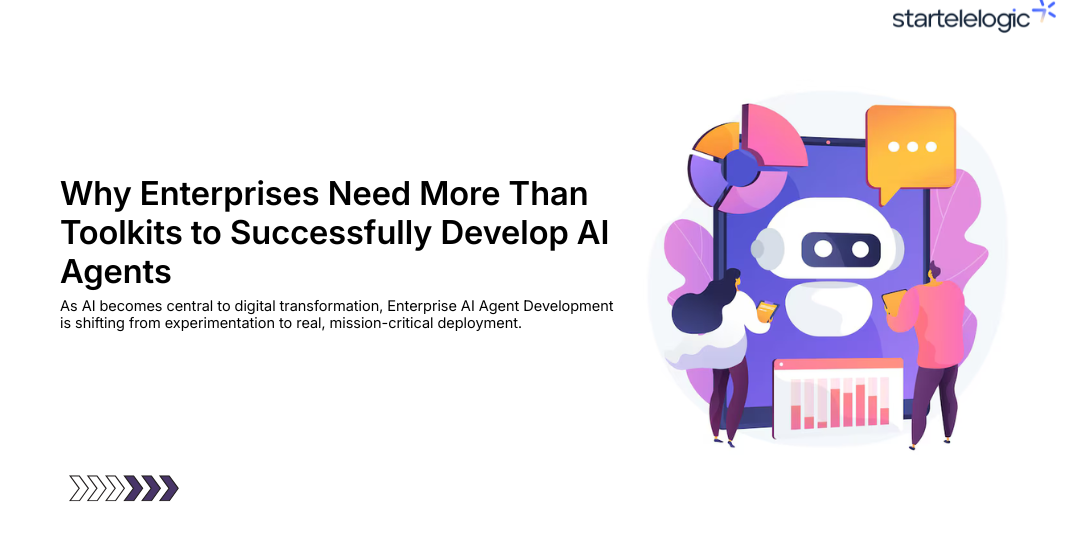
As AI becomes central to digital transformation, Enterprise AI Agent Development is shifting from experimentation to real, mission-critical deployment. Many organizations begin with open-source toolkits, simple frameworks, or do-it-yourself solutions, but soon find that these tools are not enough for the complex demands of enterprise environments. AI agents must not only perform tasks—they must integrate with existing systems, meet compliance standards, scale across departments, and operate with consistency. This is why enterprises need more than toolkits; they need a complete approach combining strategy, infrastructure, governance, and long-term operational planning to succeed in Enterprise AI development.
Toolkits Alone Aren’t Designed for Enterprise-Grade Reliability
While toolkits are useful for prototyping, they lack the depth required for secure, stable, and large-scale operations inside an organization. Enterprise teams must consider data privacy, model transparency, user authentication, auditability, and ongoing maintenance—factors that most standalone tools are not built to handle. In real-world AI agent development, agents must interact with sensitive information, perform tasks across multiple platforms, and make decisions that affect core business operations. Without enterprise-grade reliability, AI agents become risky to deploy. This is why enterprises rely on comprehensive Enterprise AI solutions that provide built-in policy controls, robust infrastructure, and consistent performance across all business functions.
Enterprises Require Complete AI Agent Infrastructure, Not Just Development Frameworks
Building a functioning AI agent is only the first step; the true challenge is supporting it with the right AI agent infrastructure. Enterprises need secure data access systems, vector databases for memory, orchestration layers to manage workflows, knowledge bases, APIs for system integration, and monitoring tools that track agent performance in real time. A toolkit cannot deliver all these essential components. For AI agents to work across customer support, HR, operations, finance, and IT, the enterprise needs a unified infrastructure capable of handling diverse workloads. Only with a full AI foundation can agents remain accurate, efficient, and dependable as they grow and interact with more systems.
A Clear Enterprise AI Strategy Must Come Before Technology Choices
Many organizations jump straight into building AI agents because toolkits make it seem quick and easy. But without a long-term Enterprise AI strategy, these efforts often fail or result in disjointed solutions that don’t create measurable impact. A strong strategy defines the business goals, identifies the processes AI can improve, establishes KPIs for success, and outlines how the agent will evolve over time. It also helps determine whether the enterprise needs automation agents, reasoning agents, decision-making agents, or cross-functional assistants. When Enterprise AI Agent Development aligns with strategy instead of improvisation, companies avoid trial-and-error and build solutions that solve real problems.
Also Read: https://bit.ly/3MjCpes
AI Agent Platforms for Enterprises Enable Security, Scalability, and Governance
Toolkits are not enough when an organization needs multiple agents, consistent governance, or enterprise-wide deployment. Modern AI agent platforms for enterprises offer a controlled environment where companies can build, deploy, and manage dozens or even hundreds of AI agents simultaneously. These platforms provide secure data connectors, prebuilt automation workflows, on-premise or cloud-based deployment options, user access controls, and analytics dashboards that track agent performance. They also include compliance features like data masking, logging, and fine-grained permission control. For enterprises that need stability as they grow, these platforms remove the heavy lifting and allow internal teams to focus on creating value, not solving technical bottlenecks.
Governance, Compliance, and Risk Management Go Beyond What Toolkits Offer
Enterprises operate under strict regulatory frameworks such as GDPR, HIPAA, SOC2, ISO, and internal corporate policies. Toolkits rarely include the governance capabilities required to ensure compliance at scale. In enterprise-level AI agent development, companies must understand how agents use data, how predictions are made, and how decisions are logged for auditing. They need guardrails that prevent unauthorized actions, bias detection systems to protect fairness, and continuous monitoring to catch model drift early. This level of governance cannot be achieved with toolkits alone. Only enterprise-ready governance frameworks make Enterprise AI solutions trustworthy, secure, and safe for real-world use.
Operationalizing and Managing AI Agents Is the Real Enterprise Challenge
Most toolkits help build AI agents but offer little support for what comes next: continuous improvement, maintenance, security updates, retraining, debugging, and integrating new data sources. Operationalization—also known as AIOps—is where enterprises either succeed or fail. Successful Enterprise AI development requires teams to manage agent performance, track user interactions, analyze system logs, and deploy updates without disrupting workflows. Enterprises also need a feedback loop where agents learn from real usage data and improve over time. Without proper operations, AI agents quickly become outdated or unreliable, leading to poor user experiences. This is why mature operational frameworks are essential to sustainable Enterprise AI Agent Development.
Conclusion: Enterprises Need Ecosystems, Not Just Toolkits
AI agents are powerful tools, but toolkits alone cannot meet the complexity, scale, and reliability demands of large organizations. To succeed with Enterprise AI development, companies need a complete ecosystem that includes strategy, infrastructure, governance, and operational excellence. By adopting unified AI agent platforms for enterprises and building strong Enterprise AI solutions, organizations can deploy AI agents that are secure, scalable, resilient, and capable of driving real business transformation. In the end, true Enterprise AI Agent Development requires more than tools—it requires a vision, a strategy, and a robust foundation that supports growth for years to come.
FAQs About Enterprise AI Agent Development
1. What is Enterprise AI Agent Development?
Enterprise AI Agent Development refers to building AI agents specifically designed to operate within large organizations, integrating with internal systems, managing secure data, and supporting complex workflows at scale.
2. Why are toolkits not enough for Enterprise AI development?
Toolkits are great for experimentation but lack enterprise-level security, compliance, scalability, and integration capabilities required for real Enterprise AI Agent Development in production environments.
3. What infrastructure is required for enterprise-grade AI agents?
Enterprises need structured AI agent infrastructure including data pipelines, APIs, vector databases, orchestration layers, monitoring tools, and governance systems to support reliable, long-term agent functionality.
4. How does strategy impact Enterprise AI Agent Development?
A clear Enterprise AI strategy ensures that AI agents are aligned with business objectives, measurable KPIs, and operational goals—reducing wasted time and enabling more effective deployment.
5. What makes AI agent platforms valuable to enterprises?
AI agent platforms for enterprises provide built-in security, scalability, lifecycle management, governance tools, and integrations, making enterprise deployments far more stable and efficient than using standalone toolkits.
6. What governance measures are essential for enterprise AI agents?
Enterprises need compliance controls, audit logs, identity management, bias detection, and data protection to ensure their Enterprise AI solutions meet regulatory and internal standards.
7. How can enterprises operationalize AI agents successfully?
Successful operationalization in Enterprise AI Agent Development involves continuous monitoring, retraining, performance tuning, and system integration to keep agents accurate, secure, and effective over time.